In short: Knowing how to choose a domain matters because the name becomes the address of your website and your business e-mail for years. A good domain is short, easy to say and spell, does not clash with another brand and uses an extension that suits your audience; it should also be registered in your company's own name.
A domain name is the address people type to reach your site; if you want the technical background first, our article on what a domain name is covers the basics. This guide focuses on finding the name itself: ten rules to check before you click register, a comparison of extensions and a short checklist.
A domain is more than a web address. It appears on business cards, invoices, vehicle graphics and every e-mail signature. You can change it later, but it is costly: you need redirects from the old address, new e-mail addresses, reprinted materials and a move of the search visibility you have built up. Spending a few days on research is far cheaper than a migration later.
A short name is easier to remember, less likely to be mistyped and looks tidy in an e-mail address. The technical limit is generous: under RFC 1035 each part (label) of a domain name can be at most 63 characters. In practice, aim for a length someone can spell correctly after hearing it once.
If you have to spell it letter by letter on the phone, the name is too hard. Say it aloud to a few people and ask them to write it down; if everyone writes it the same way, it is a good candidate.
Domain names may contain letters, digits and hyphens (-), and a label cannot start or end with a hyphen. Being allowed does not make them a good idea: an address such as "best-tech-service" is easily typed as "besttechservice" after someone hears it, and a digit raises the question of "5" or "five".
Names with characters such as ç, ğ, ö, ş or ü are registered as internationalised domain names (IDN) and are converted in the background into an ASCII form that starts with "xn--". Some mail programs and forms may show that form. Many businesses use a spelling without special characters as the main address and redirect the accented version to it.
The extension is the ending of the address, such as .com, .com.tr or .net. For a business serving customers in Turkey, .com.tr is a strong local signal; if you sell abroad, .com may feel more familiar. For newly launched endings, see our new domain extensions announcement.
A free domain does not mean you have the right to use the name. A domain that resembles another company's registered trademark can lead to a dispute later. Before you decide, search the Turkish Patent and Trademark Office records (or your own country's trademark register) for similar marks, and consider registering your own trademark.
If the same name is available on social media, customers find you under one name on every channel. Check the username on the platforms you plan to use before you register the domain.
If your name is often misspelled, registering those spellings and redirecting them to your main address keeps visitors from landing on someone else's site. For the same reason, holding your main name in more than one extension, such as .com.tr and .com, protects your brand.
Your domain will also be part of your business e-mail address. Write and read it with "firstname.lastname@" in front; a long or confusing name gets even harder in e-mail.
The registrant should be your company, not an agency or an employee. If you do not want contact details to be public, look at WHOIS privacy. Missing the renewal date can take your website and e-mail offline; our article on an expired domain explains what can happen.
| Extension | Best suited for | Good to know |
|---|---|---|
| .com.tr | Businesses serving customers in Turkey | Allocated first come, first served without documents since 14 September 2022 |
| .com | Businesses with international customers or a single global brand | The most familiar ending; short names are often taken |
| .net.tr and .org.tr | Internet and network service providers (.net.tr), associations and foundations (.org.tr) | Same TRABİS rule as .com.tr |
| .net and other generic endings | Alternatives when the .com is taken | Visitors may type .com out of habit; holding both is safer |
According to TRABİS, the Turkish registry, and its announcement on document-free registration, .com.tr, .net.tr and .org.tr no longer require documents; names on the closed or restricted lists (TAKAL and TAKIL) are excluded from this rule.
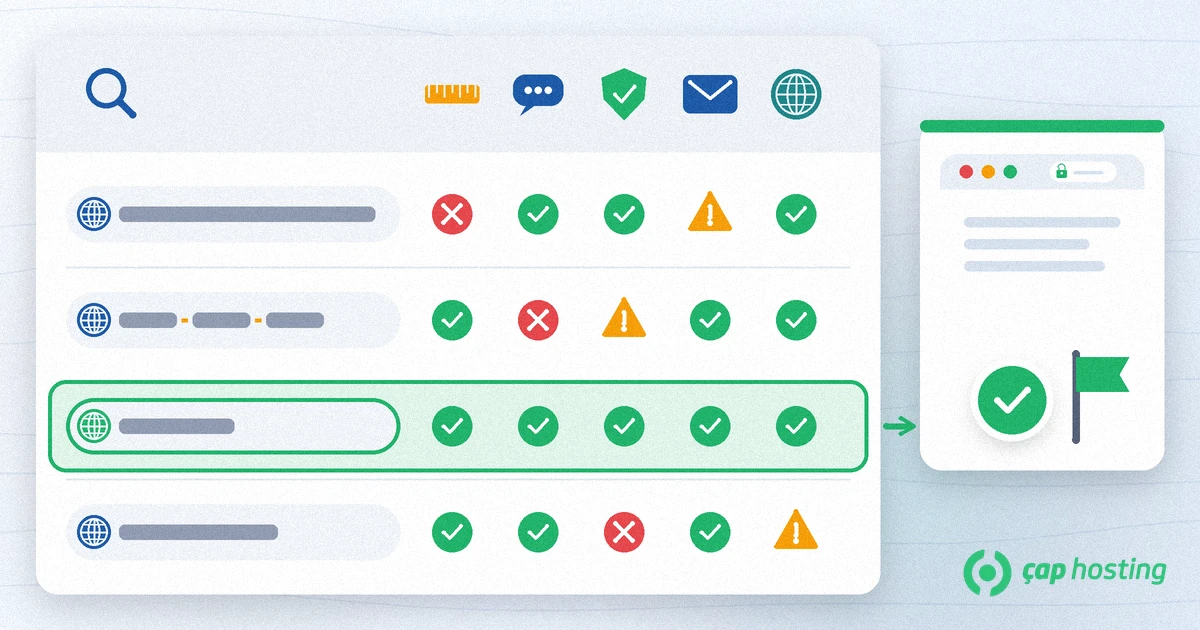
In summary, a good domain is short, spelled the way it sounds, consistent with your brand and on the right extension. Once your shortlist passes this checklist, check availability on the ÇAP Hosting domain registration page and complete your registration.
Make sure the name is short, easy to say and spell and does not clash with another brand. Then pick the extension that suits your audience and register the domain in your company's name.
No. According to TRABİS, since 14 September 2022 .com.tr, .net.tr and .org.tr domains are allocated without documents to whoever applies first. Names on the closed or restricted lists are the exception.
A spelling without special characters is usually more practical as the main address, because it causes fewer problems in e-mail and forms. You can register the accented version as well and redirect it to the main address.
It is not required, but holding your main name in the most likely extensions, such as .com.tr and .com, protects your brand and keeps visitors from reaching the wrong site.
 Copyright © 2026 All Rights Reserved

 Turkey (Türkçe)
 Worldwide (English)